[[Earth API]]
- climate
- research
- development
- design
Climate data has a distribution problem.
When we were building out Anthropogenic's infrastructure, we kept running into the same wall: if you wanted live environmental data atmospheric CO₂ readings, methane concentrations, nitrous oxide levels your options were limited. You could pay for a managed data product through AWS or Google's BigQuery ecosystem, or you could go directly to the source. Going to the source mostly meant navigating NOAA and NASA's older data infrastructure, a lot of which was still served over FTP. Functional for researchers, but not exactly what you'd reach for when building a modern product.
There wasn't a clean middle path. No lightweight, well-documented REST API that just handed you queryable climate data without a significant lift to get started.
So we built one.
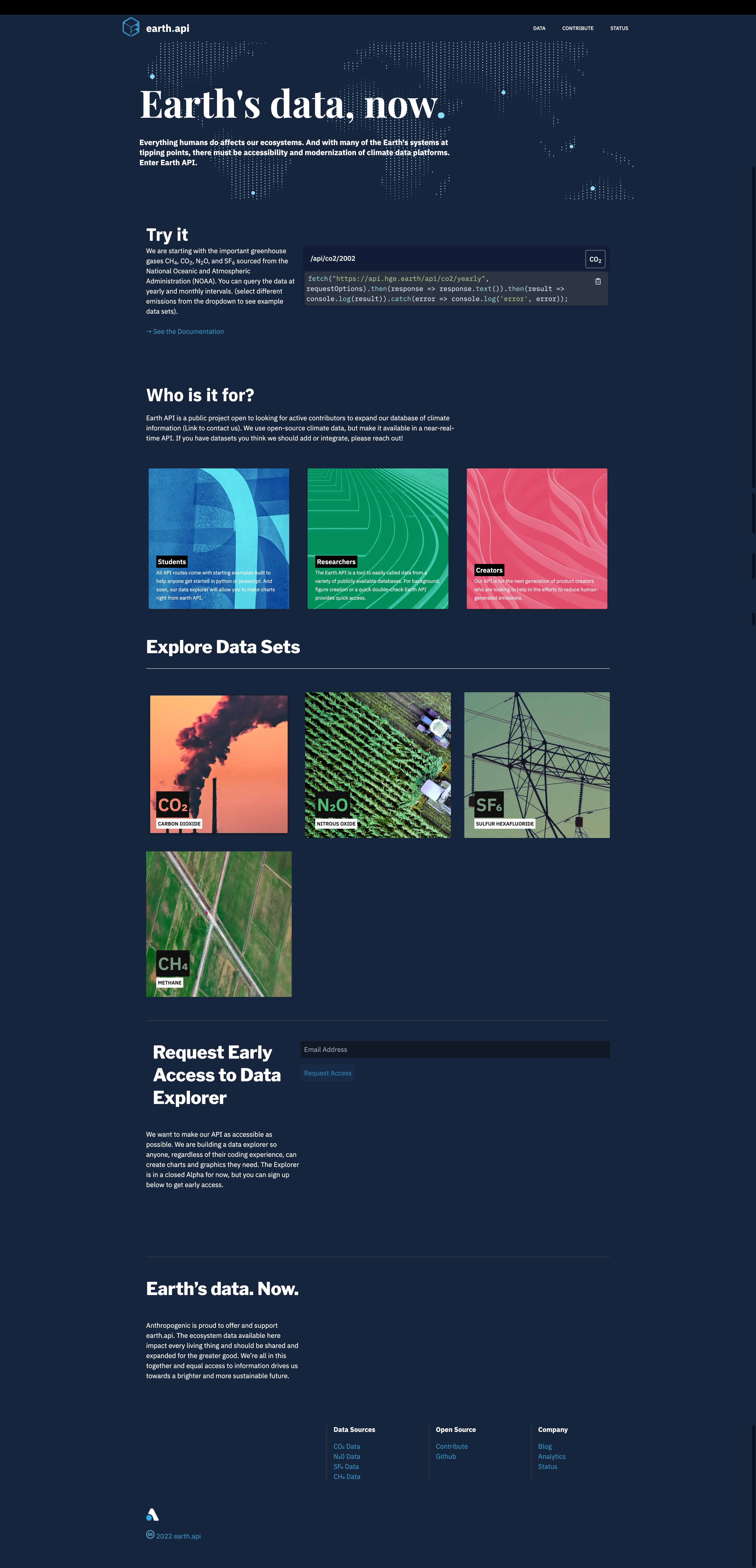
Earth API is a simple open-source API that pulls from NOAA's atmospheric datasets CO₂, CH₄, N₂O, and SF₆ and makes them available at a modern endpoint you can call from any project in a few lines of Python or JavaScript. The idea wasn't to replace the source data or add interpretation on top of it; it was just to remove the friction between "I want to understand what's happening with atmospheric methane" and actually getting that data into something you're building. You can query by year or month, and every route ships with starter examples to lower the barrier even further.
fetch("https://api.hge.earth/api/co2/yearly", requestOptions)
  .then(response => response.text())
  .then(result => console.log(result))
It was built as an internal tool first part of the same infrastructure layer that would eventually power Scope 6's emissions verification. But we open-sourced it because the problem it solved wasn't unique to us. Students, researchers, and product builders all hit the same wall when they try to work with public environmental data. The data exists. It's just not accessible in the way modern development workflows expect.
This is a problem space I expect to keep coming back to. The gap between "the data is technically public" and "the data is actually usable" is where a lot of good climate work stalls, and I don't think it's fully solved yet.
→ View Earth API · GitHub
Before I left Anthropogenic, we completed the first review of the design and launched the on Product Hunt. It seems to have a really good reception among scientists, and I'm excited to see how this could grow or be shaped differently in the future.